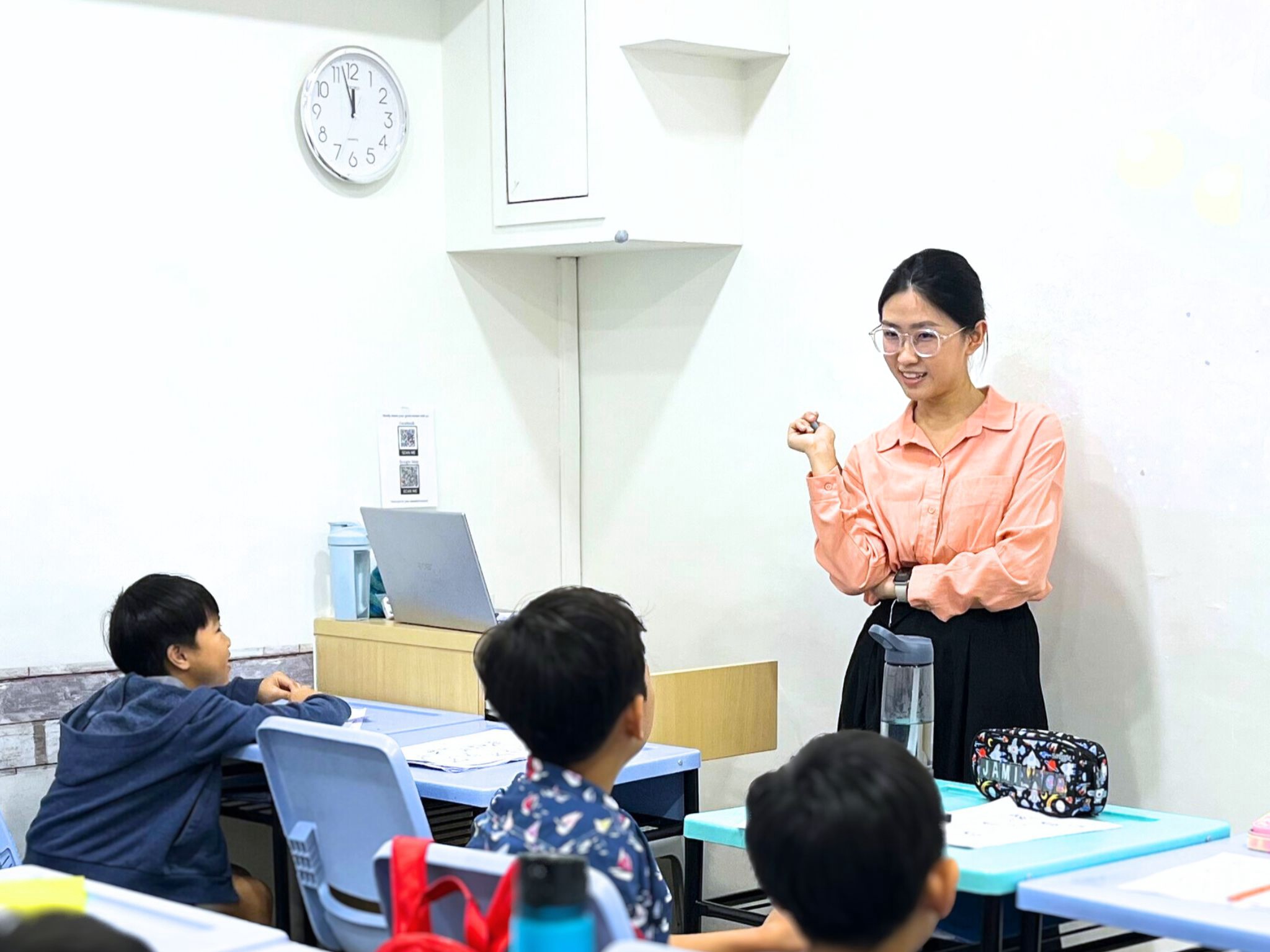

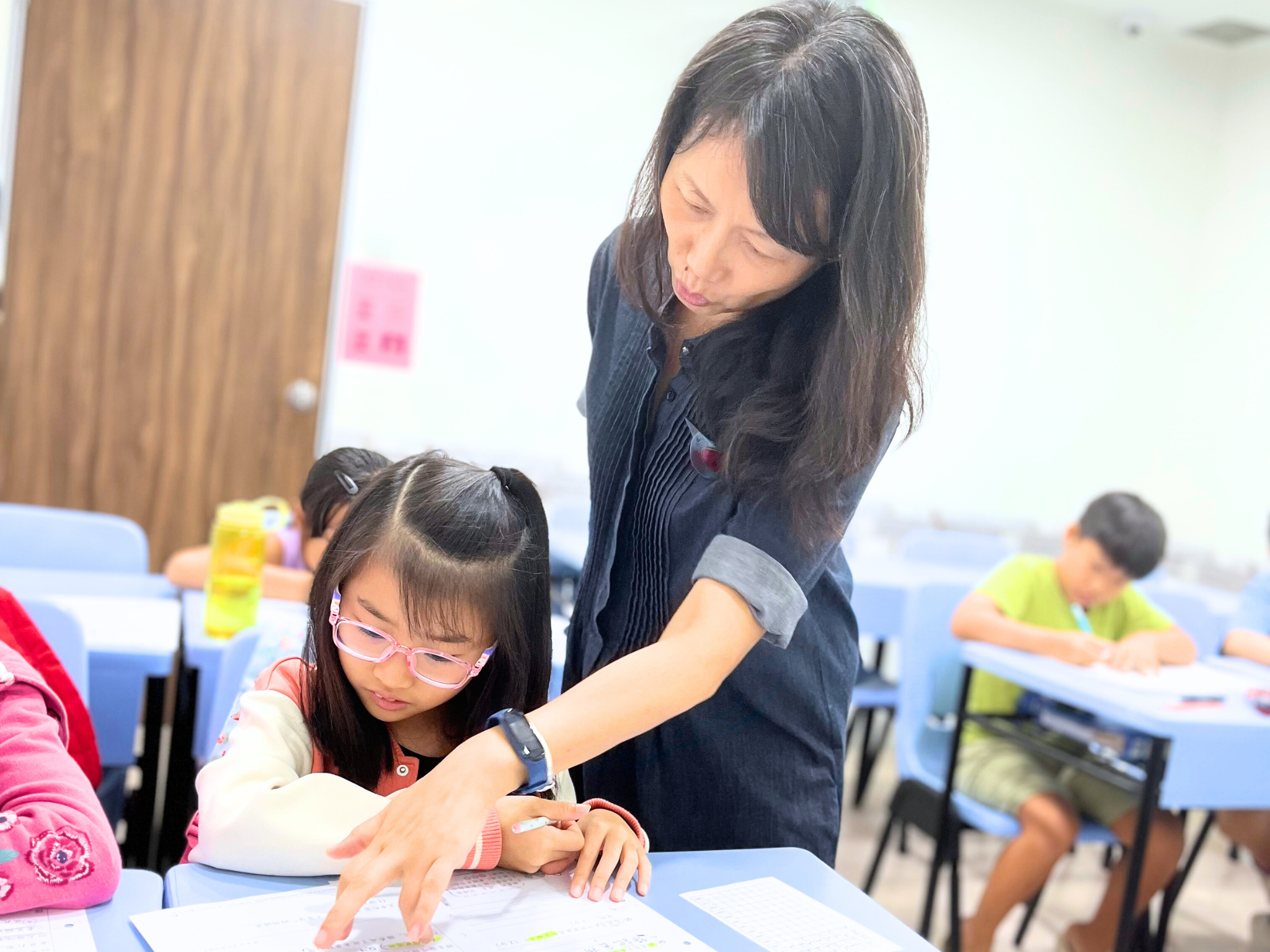



Book a trial lesson and let our team recommend the most suitable programme for your child

Find the student’s specific language, answering and exam-related gaps.

Break difficult skills into clear and manageable steps.

Use guided exercises to help students apply each technique.

Review mistakes, explain why marks were lost and show students how to improve their next attempt

PSLE Chinese pass rate
More than 95% achieving AL1 or AL2
More than 50% achieving A1 or A2
Specialise in Chinese Language Enrichment courses Course curriculum systematically developed by our founders Systematic and effective teaching method Highly qualified professional teachers registered with MOE Enhance students’ learning of the Chinese Language
PSLE Chinese pass rate
More than 95% achieving AL1 or AL2
More than 50% achieving A1 or A2

Find the student’s specific language, answering and exam-related gaps.

Break difficult skills into clear and manageable steps.

Use guided exercises to help students apply each technique.

Review mistakes, explain why marks were lost and show students how to improve their next attempt

Busy Bees Learning Centre was founded by three dedicated Chinese language educators with a shared belief: that every child in Singapore can thrive in Chinese — with the right teaching, the right environment, and the right enrichment. Together, our founders bring more than 84 combined years of experience in Chinese language education. Their careers span MOE schools across Singapore, and their commitment to meaningful, student-centred Chinese tuition is the foundation on which BBLC was built.
Mdm Chong brings more than 28 years of classroom experience in Chinese language education to BBLC.
Her postgraduate specialisation in teaching Chinese at secondary school level means she understands precisely how students develop and where they need the most support through the Chinese tuition curriculum.
Postgraduate Diploma in Education — Teaching Chinese at Secondary School Level, NIE/NTU
BA Chinese Literature, National Taiwan University
The Chinese High School · Fuchun Secondary · Hong Kah Secondary
With a BA in Chinese Language from NUS and 28+ years in MOE schools, Mdm Chua brings both academic rigour and practical classroom experience to BBLC’s Chinese tuition programmes.
Promoted to GEO 1A in 1995, she specialises in oral Chinese, composition, and reading — enrichment areas where expert-led tuition makes the greatest difference.
Certificate in Education with Credit — Teaching Chinese Language, NIE
BA Chinese Language, National University of Singapore
Promoted to GEO 1A, 1995 · The Chinese High School · Victoria Secondary
Mdm Kui’s training at the National Taiwan Normal University — one of Asia’s foremost institutions for Chinese language teacher education — gives her a deep command of Chinese that she has spent 28+ years passing on to students in Singapore.
Her strengths in essay-writing and reading directly shape BBLC’s composition and comprehension enrichment courses.
Certificate in Education (Chinese Language), Taiwan
BA Chinese Language, National Taiwan Normal University
Promoted to GEO 1A, 1996 · The Chinese High School · Foon Yew High School
What unites our three founders is a teaching philosophy that goes beyond drilling exam techniques. Chinese language learning should build real fluency, these the gives students the confidence to speak, write, and think in Chinese, not just pass a test. This philosophy shapes every programme at BBLC: from K1–K2 Chinese enrichment courses for young learners, to primary school composition and comprehension tuition, to secondary school oral and Higher Chinese programmes.
The three founders are all qualified and experienced ex-teachers from a top local secondary school.
They have many years of teaching experience, and are knowledgeable of and well-versed in the MOE Chinese Language syllabus and curriculum.
Our teachers are registered with MOE to teach our Centre’s courses.
Our teachers are graduates of local, Malaysia, China, Taiwan universities and other education institutions.
The biggest misconception is that learning Chinese simply means memorising more words.
In reality, Chinese improves when students learn how to think in the language and how to structure their responses effectively.
Busy Bees focuses on systematic training rather than repetitive drilling.
Instead of simply asking students to do more practice papers, we teach them:
how to analyse exam questions
how to structure answers
how to develop ideas in writing.
Our goal is not just to prepare students for one exam, but to help them build confidence and real language ability.
Our philosophy is simple:
Students should understand the language, not fear it.
When students learn Chinese through clear strategies and structured guidance, they gain confidence and start to enjoy the process of learning.
We emphasise:
exam awareness
answer structuring
content development
error analysis
Students learn not just what the correct answer is, but why marks are lost and how to improve next time.
“Chinese is not about memorising more words — it’s about understanding how to think, express, and respond clearly in the language.”
A typical lesson includes:
This ensures that students learn actively rather than passively completing worksheets.
We focus on developing:
reading comprehension strategies
answer structuring techniques
composition planning and development
vocabulary usage in context
exam awareness.
Some methods we use include:
Error-based revision – students analyse their own mistakes to identify patterns.
Straits Time Interview
Question-first reading – students read comprehension questions before the passage so they know what to look for.
Content banks for composition – students build adaptable phrases and story ideas for common themes.
Straits Time Interview
These strategies help students study smarter instead of simply studying longer.
Many students come to us feeling:
confused about how to approach Chinese exams
lacking confidence in writing
frustrated that their effort does not produce results.
Students usually become:
more confident answering comprehension questions
more organised in their writing
clearer in expressing ideas.
Most importantly, they begin to see Chinese as manageable rather than intimidating.
Parents often notice that their child:
spends less time feeling stuck on homework
becomes more confident discussing Chinese work
writes more structured compositions.
We once had a student who used to cry whenever she received her composition results because her essays were covered with corrections.
Through structured training and content development, she gradually learned how to organise her ideas. Within several months, she not only improved her grades but also wrote a heartfelt Chinese letter to thank her teacher.
Moments like these remind us that improvement is not just about marks — it is also about restoring confidence in the language.
BBLC Podcast Q&A v2
Busy Bees has been specialising in Chinese education since the year 2000, with more than two decades of teaching experience.
Busy_Bee_FB_Scripts_PSLE Chines…
Over the years, Busy Bees has supported thousands of students through different stages of their Chinese learning journey.
We started Busy Bees because we saw many capable students struggling with Chinese despite putting in great effort.
Our goal was to create a learning environment where students could learn Chinese with confidence, structure, and clear strategies.
During the trial lesson, students will:
experience our structured teaching method
practise answering techniques
receive feedback on their responses.
Parents will also gain a clearer understanding of how we approach Chinese learning.
Students will experience a supportive classroom environment where learning Chinese feels structured and manageable.
The goal is for them to realise that Chinese can be learned step by step.
The trial lesson is suitable for students who:
feel stuck in their Chinese progress
lack confidence in comprehension or writing
want clearer strategies for improvement.
The trial lesson allows parents and students to see how structured teaching can make Chinese more accessible.
It helps students understand that improvement is possible with the right guidance.
Chinese improves not when students study longer, but when they learn the right strategies and develop confidence using the language.
Students improve the fastest when they:
review mistakes carefully
practise with clear strategies
focus on understanding rather than memorising.
When learning becomes structured and purposeful, Chinese becomes much less intimidating — and much more achievable.